This is the story of Shinrone:
a village, its people, and its history.
“With curiosity and through meaningful conversation, we will respectfully discover and collate the unique stories and values of Shinrone with the end goal of developing a picture of the village that is true to its character, celebratory of its history, representative of its present and beneficial to its future.”
Finding Shinrone is a snapshot of a village, its people and its history. This project was produced by srudents of the Cultural Event Management postgraduate course at the Institute of Art, Design and Technology Dún Laoghaire in collaboration with the people of Shinrone and with the help of Bellefield House and Joe Cleary.
From Young Hurler to Leader

The Spirit of Shinrone Camogie

The Musical Legacy of Shinrone
Now And Then

The Heart of Shinrone's Social Life
Spain's Pub, 52.984152, -7.924693
In conversation with: Hilda Ryan
For Hilda, involvement in Shinrone began about twenty-five years ago, when her children started playing camogie and hurling. Before that, despite living in the parish, connection to the wider community was limited. Like many young families, life revolved around home, work, and raising children, with few opportunities to meet others.
Sport changed that. Evenings spent on sidelines became a place to meet neighbours, build friendships, and feel part of something shared. “You wouldn’t be part of the community… only for your children playing sports,” she reflects.
Through those moments, familiar faces became friends. People who had once been strangers became part of everyday life.
When the local pub faced closure, a local businessman stepped in to keep it open, provided someone could run it. Hilda took that chance. Two years on, she finds herself at the centre of a different kind of community space, one built on conversation instead of sport.
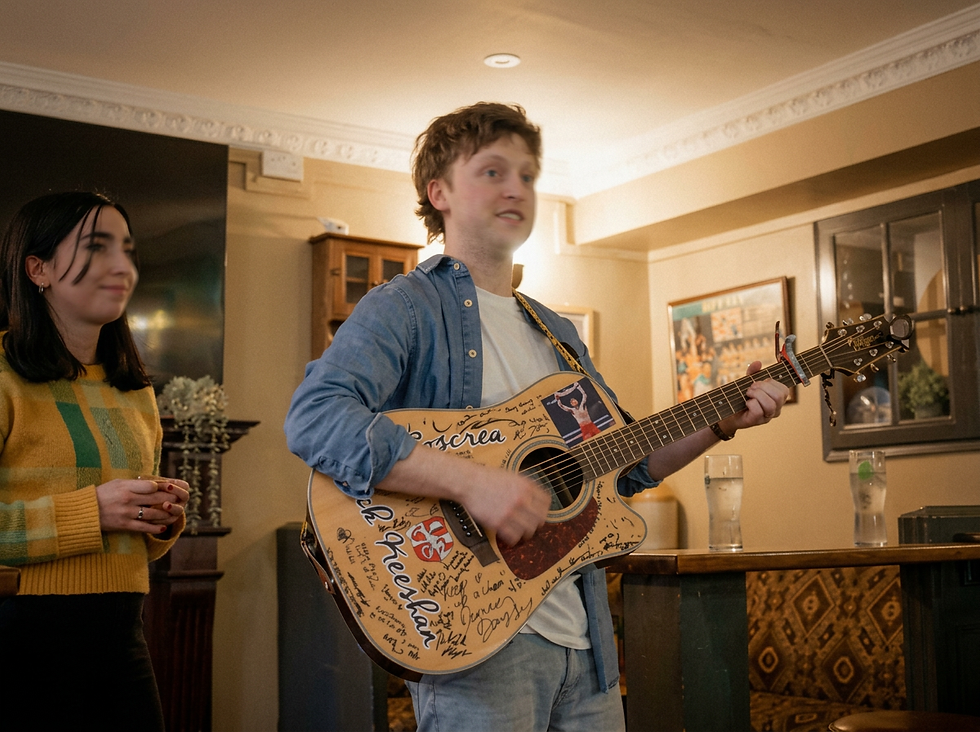
Today, the pub serves as a vital meeting point in Shinrone. Alongside the village’s other pub, it forms part of a social rhythm that supports everyday life. Each has its own group of regulars, its own atmosphere, and together they create balance within the village.
Card games take place several nights a week. Occasional music brings people together. But more than anything, it is conversation that defines the space. For many customers, particularly older ones, the pub is their social outlet, their connection to others, their routine.
“You have people who come in for their chat,” Hilda says, describing a space that keeps people engaged and connected.
There is also a quiet bridging of generations. While younger people may not come as often, when they do, they mix with older customers — sharing stories, conversations, and time. In a world where such interactions are becoming less common, the pub remains one of the few places where they still happen naturally.
Hilda speaks with honesty about the challenges facing rural pubs. The patterns that once sustained them are changing. The older generation, who form the core of regular customers, continue to support the pub. But younger people approach socialising differently.
Where once nights out were frequent and consistent, they are now occasional. Fewer visits, less regular trade, and a shift in habits all contribute to uncertainty. “In five years’ time, I wouldn’t be surprised if both pubs were closed,” she admits.
It raises difficult questions. Do pubs need to change — becoming more activity-based, less focused on drinking? And if so, how can they remain viable? The answers are not clear, but the challenge is real.
Despite this uncertainty, the role of the pub remains significant. It is a space for connection, for conversation, for community.

